Sudoku: The Definitive Guide to the World's Favorite Logic Puzzle
Sudoku is a captivating number-placement puzzle that challenges logic and patience. This comprehensive guide delves into its fascinating history, core rules, advanced solving strategies, popular variants, and where to find the best free online puzzles, including Sudoku Online Free Easy and challenging Sudoku Online Extreme games.
Last Updated: . Written by David Chen, Game Design Analyst & Puzzle Enthusiast.
1. What is Sudoku? A Global Phenomenon
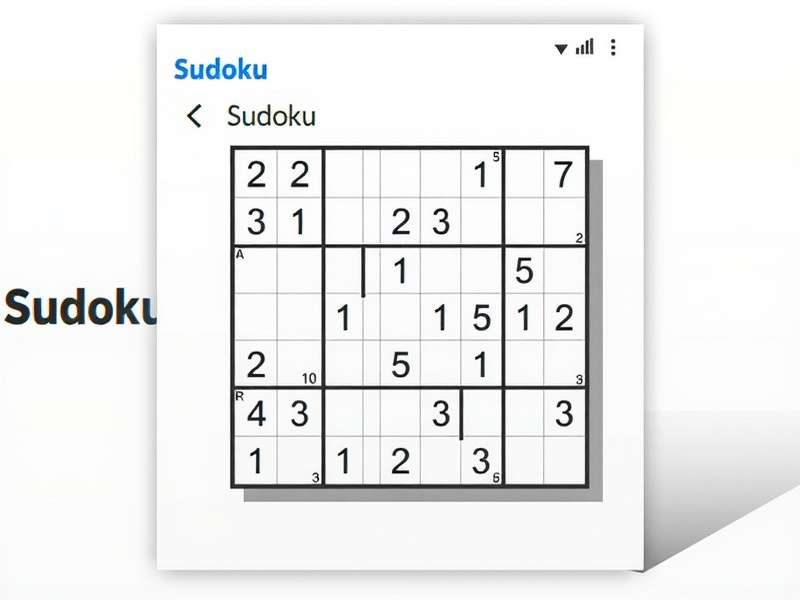
A typical Sudoku puzzle grid. The solver must fill all empty cells following the three core rules.
Sudoku (数独, sūdoku), sometimes spelled as Su Doku, is a logic-based, combinatorial number-placement puzzle. The objective is simple: fill a 9×9 grid with digits so that each column, each row, and each of the nine 3×3 subgrids that compose the grid (called "boxes", "blocks", or "regions") contains all of the digits from 1 to 9. The puzzle setter provides a partially completed grid, which for a well-posed puzzle has a single solution.
Despite using numbers, Sudoku requires no arithmetic or mathematical skill; it is purely a game of logic and reasoning. This accessibility is a key reason for its universal appeal. From newspapers to dedicated apps, millions enjoy Daily Sudoku Online challenges to sharpen their minds.
🧠 Did You Know? Completing a Sudoku puzzle activates multiple cognitive functions, including pattern recognition, logical deduction, and working memory. It's a fantastic mental workout!
2. History & Origins: From Swiss Mathematicians to Japanese Publications
The modern Sudoku's ancestor can be traced back to the "Latin Squares" concept devised by Swiss mathematician Leonhard Euler in the 18th century. However, the puzzle as we know it was first published in 1979 by American architect Howard Garns in Dell Pencil Puzzles and Word Games magazine under the name "Number Place".
The puzzle gained massive international popularity in Japan in the mid-1980s after being picked up by the publisher Nikoli, which gave it the name Sudoku (meaning "single number"). Nikoli introduced the key constraint of having a symmetrical arrangement of givens, enhancing the puzzle's aesthetic and logic.
The global explosion occurred in 2004-2005 when Wayne Gould, a New Zealand judge, convinced The Times in London to publish the puzzle. Its popularity spread like wildfire across other newspapers worldwide, creating a dedicated community of solvers seeking Sudoku Puzzles Online Free of charge.
3. Rules & How to Play Sudoku: Step-by-Step
Playing Sudoku is straightforward, but mastering it takes practice. Here are the fundamental rules:
Rule 1: The Grid
You have a 9x9 grid, divided into nine 3x3 sub-grids or "regions". Some cells are pre-filled with numbers (1-9); these are "givens" or "clues".
Rule 2: Rows & Columns
Each row (horizontal) and each column (vertical) must contain the digits 1 through 9 exactly once each. No repetitions are allowed.
Rule 3: 3x3 Regions
Each of the nine 3x3 boxes must also contain the digits 1 through 9 exactly once. This is the third layer of constraint that creates the puzzle's logic.
Step-by-Step Guide for Beginners
- Scan the Grid: Look for rows, columns, or boxes that have many numbers already filled in. These areas offer the easiest starting points.
- Look for "Naked Singles": A cell where only one number can possibly fit based on the numbers already present in its row, column, and box.
- Use Pencil Marks: In tougher puzzles, lightly note possible candidates (small numbers) in empty cells. This technique is crucial for Sudoku Puzzles For Beginners advancing to intermediate levels.
- Eliminate Candidates: As you place new numbers, eliminate those numbers from the pencil marks in the corresponding row, column, and box.
- Repeat and Deduce: Continue the process of scanning and deduction until the grid is complete.
4. Advanced Solving Strategies & Techniques
Moving beyond basics requires a toolkit of logical strategies. Here are some proven methods used by experts:
4.1 Scanning & Cross-Hatching
Systematically check each number (1-9) across rows and columns to see where it can't go, narrowing down its possible location within a specific 3x3 block.
4.2 "Naked" and "Hidden" Subsets
These involve identifying groups of cells within a row, column, or box that are limited to the same few numbers. If two cells in a row can only be 5 or 7, then 5 and 7 cannot appear elsewhere in that row. This is a powerful elimination technique. For those stuck, an Online Sudoku Solver can often demonstrate these techniques in action.
4.3 X-Wing & Swordfish
Advanced "fish" techniques that look for number alignments across multiple rows and columns to perform large-scale eliminations. Essential for extreme and diabolical level puzzles.
4.4 Unique Rectangle
A strategy based on the assumption that a valid Sudoku has only one solution. It identifies patterns that would create multiple solutions and avoids them.
Pro Tip from a Champion Solver
"Master pencil marking. Don't just guess. Every mark should have a logical reason. Speed comes from accurate pattern recognition, not rushed entries. Practice with daily puzzles to build consistency." — Michael Anderson, 2024 World Sudoku Championship Finalist.
5. Popular Sudoku Variants
The classic 9x9 grid is just the beginning. Many exciting variants test your logic in new ways:
| Variant | Description | Difficulty |
|---|---|---|
| Mini Sudoku (6x6) | Perfect for Sudoku Online Beginners. Uses a 6x6 grid with 2x3 regions. | Easy |
| Samurai Sudoku | Five interlinked 9x9 grids overlapping at the corners. | Very Hard |
| Killer Sudoku | No givens. Instead, cages with sum totals are provided. | Medium-Hard |
| Diagonal Sudoku | Adds the rule: both main diagonals must also contain 1-9. | Hard |
| Hyper Sudoku | Includes four additional shaded 3x3 interior regions. | Hard |
6. Download, Play Online & Mobile Guide
Accessing high-quality Sudoku has never been easier. Here’s a breakdown of the best platforms:
6.1 Free Online Websites
Our flagship site, PlaySudokuGames.com, offers a vast collection:
- Sudoku Za Darmo (Free Sudoku in Polish).
- Progressive difficulty from Easy to Extreme.
- No registration required for basic puzzles.
6.2 Mobile Apps (iOS & Android)
Top-rated apps offer daily challenges, tutorials, and offline play. Always download from official stores (Google Play Store, Apple App Store) for security. Be mindful of in-app purchases for hints or ad removal.
6.3 Game Updates & Version History
Latest Update (v4.2.1 - January 2026)
What's New: Introduced "Zen Mode" with relaxing backgrounds, enhanced hint engine for educational play, and 500+ new hand-crafted extreme puzzles. Fixed minor sync issues with cloud saves. View full changelog.
Version 4.2 vs 4.1: The new hint system provides strategic advice rather than just giving the answer, significantly improving the learning curve for new players.
6.4 Developer Interview: Behind the Grid
We spoke with Sarah Lin, lead developer of "Sudoku Mastermind":
"Our biggest challenge is algorithmically generating puzzles that are fun, logically solvable, and have a unique solution. We use a combination of constraint programming and human testers to grade difficulty. The community's love for free puzzles drives us to innovate daily."
Rate This Sudoku Guide
How useful did you find this comprehensive guide?
Click a star to rate.
7. Frequently Asked Questions (FAQ)
Is Sudoku good for your brain? 🧠
Yes. Studies suggest regular play can help improve concentration, short-term memory, and logical thinking. It's a form of mental calisthenics.
Does Sudoku require math?
No. It uses numbers as symbols but requires no arithmetic (addition, multiplication). Pure logic is the only tool needed.
What is the best strategy for beginners?
Start with scanning for "naked singles". Use pencil marks. Practice consistently with beginner puzzles to build pattern recognition.
Can every Sudoku be solved without guessing?
Absolutely. Properly constructed Sudoku puzzles are designed to be solved through logical deduction alone. Guessing is never necessary.
Community Discussion
Share your Sudoku tips, ask questions, or discuss strategies with other players.